Lunar eclipse: Century's longest 'blood moon' under way Science & Environment ...
Science & Environment Science & Environment Lunar eclipse: Century's longest 'blood moon' under way
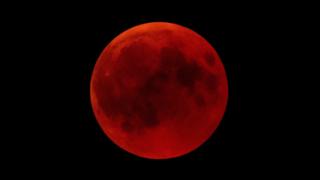 Image copyright Getty Images
 Skywatchers are being treated to the longest "blood moon" eclipse of the 21st Century.
As it rises, during this total eclipse, Earth's natural satellite turns a striking shade of red or ruddy brown
The "totality" period, when light from the Moon is totally obscured, will last for one hour, 43 minutes.
At least part of the eclipse is visible from Europe, the Middle East, Africa, Australia, most of Asia and South America.
- In pictures: Blood moon seen around the world
In the UK, the Moon would have appeared entirely red, fully eclipsed by Earth, from when it rose at 21:00 until 22:15 BST - except clouds obscured the views for many.
On the same night and over the coming days, Mars will be at its closest point to Earth since 2003 - visible as a "bright red star" where skies are clear.
Why will the eclipse last so long?
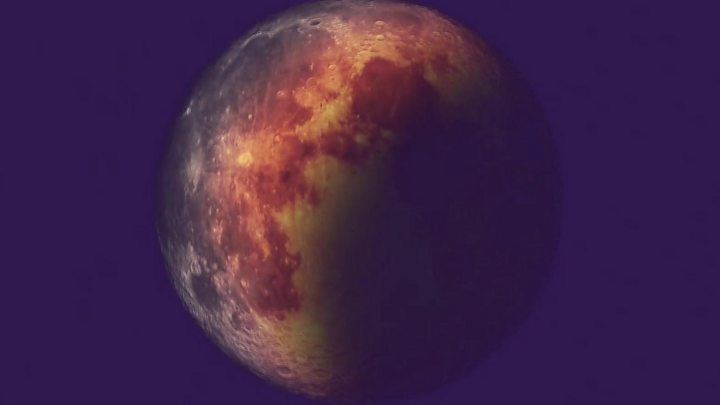
The Moon passes right through the centre of the Earth's shadow, at the shadow's widest point.
 Media playback is unsupported on your device
 "This is actually almost as long as a lunar eclipse could be," Prof Tim O'Brien, an astrophysicist at University of Manchester, explained.
It coincides not only with Mars's close approach, but with what he described as a "procession of planets" - a line-up of our celestial neighbours that will give skywatchers a particularly good view of Venus, Jupiter, Saturn and Mars.
Eclipse terms
Umbra: The darker, central part of the Earth's shadow
Penumbra: The lighter, outer part of the shadow cast by our planet
Because the Moon is far away from Earth relatively speaking - its orbit is an ellipse, so it moves closer and further and looks larger and smaller from Earth.
"Mars will look like this beautiful bright red star just below the Moon," said Prof O'Brien.
"Every couple of years or so, the Earth overtakes Mars on the inside as it orbits the Sun, so Mars is closest to us.
"And because of the elliptical shape of the orbit, it's even closer than normal; it really is a great time to spot Mars."
Where will the eclipse be visible?
Where skies are clear of cloud, the spectacle is visible almost everywhere around the world, with the exception of North America.
The eclipse had already started by the time the Moon rose over the UK and Western Europe.
The best views - weather permitting - were expected to be across Eastern Europe, Central and East Africa and South East Asia, from where t he entire eclipse is visible.
Dr Emily Brunsden, director of the University of York's Astrocampus, added that this eclipse was a "micro blood moon".
"This is a total eclipse at a time in its orbit when it is close to being the farthest from Earth, or at apogee," she said.
"Hence the Moon is fractionally smaller than usual."
Follow Victoria on Twitter
Stages of a total lunar eclipse
- Penumbral eclipse begins: This starts w hen the outer (and lighter) part of the Earth's shadow begins moving across the Moon
- Partial eclipse begins: This stage takes hold when the darker, inner part of the Earth's shadow (umbra) begins covering the Moon
- Total eclipse begins: Also called totality, this occurs when the umbra completely covers the Moon, turning it a reddish brown colour
- Maximum eclipse: The mid-point of totality
- Total eclipse ends: The umbra starts moving away from the Moon's face after totality
- Partial eclipse ends: Earth's umbra completely leaves the surface of the Moon
- Penumbral eclipse ends: The outer part of the shadow (penumbra) completely moves away from the Moon
Source: timeanddate.com
Will you be watching out for the "blood moon"? Send pictures or video to yo urpics@bbc.co.uk
Please include your name and location when sending your pictures. Please include a contact number if you are willing to speak to a BBC journalist. You can also contribute your images in the following ways:
- WhatsApp: +44 7555 173285
- Or Upload your pictures/video here
- Tweet: @BBC_HaveYourSay
- Send an SMS or MMS to 61124 (UK) or +44 7624 800 100 (international)
- Please read our terms & conditions and privacy policy
Top Stories
World watches century's longest blood moonDuring this total eclipse, Earth's natural satellite turns a striking shade of red or ruddy brown.
27 July 2018 CBS investigates claims of misconduct 27 July 2018 UK MPs call for social media regulation 27 July 2018Features
World awaits century's longest blood moon
VideoFox v MSNBC: How the news divides America
The drug causing chaos in prisons
Why does rain smell so good?
VideoThe moment a mother and son are reunited
Facebook's massive selloff explained
Custody battle after Briton's Shanghai murder
Why wildfires are breaking out in the 'wrong' countries
BBC Culture: The Bond film that was never made
Elsewhere on the BBC
Football phrases
15 sayings from around the world
Full article Football phrases Why you can trust BBC NewsBBC News Services
- On your mobile
- On your connected tv
- Get news alerts
- Contact BBC News
No comments