100 years later, the madness of daylight saving time endures GIVE NOW Close Popup ...
GIVE NOW Close Popup PBS NewsHour Logo: Home
One hundred years after Congress passed the first daylight saving legislation, more and more people are doubting the wisdom of changing the clocks.
In August, the EU Commission proposed ending the biannual practice.
Last winter, lawmakers in Florida passed the “Sunshine Protection Act,†which will make daylight saving a year-round reality in the Sunshine State.
If approved by the federal government, this will effectively move Florida’s residents one time zone to the east, aligning cities from Jacksonville to Miami with Nova Scotia rather than New York and Washington, D.C.
The cost of rescheduling international and interstate business and commerce hasn’t been calculated. Instead, relying on the same overly optimistic math that led the original proponents of daylight saving to predict vast energy savings, crisper farm products harvested before the morning dew dried and lessened eye strain for industrial workers, Florida legislators are lauding the benefits of putting “more sunshine in our lives.â€
It’s absurd â€" and fitting â€" that a century later, opponents and supporters of daylight saving are still not sure exactly what it does. Despite its name, daylight saving has never saved anyone anything. But it has proven to be a fantastically effective driver of retail spending.
Making the trains run on time
For centuries people set their clocks and watches by looking up at the sun and estimating, which yielded wildly dissimilar results between (and often within) cities and towns.
To railroad companies around the world, that wasn’t acceptable. They needed synchronized, predictable station times for arrivals and departures, so they proposed splitting up the globe into 24 time zones.
In 1883, the economic clout of the railroads allowed them to replace sun time with standard time with no legislative assistance and little public opposition. The clocks were calm for almost 30 years, apart from an annual debate in the British Parliament over whether to pass a Daylight Saving Act. While proponents argued that shoving clocks ahead during summer months would reduce energy consumption and encourage outdoor recreation, the opposition won out.
Then, in 1916, Germany suddenly adopted the British idea in hopes of conserving energy for its war effort. Within a year, Great Britain followed suit. And despite fanatical opposition from the farm lobby, so would the United States.
From patriotic duty to moneymaking scheme
A law requiring Americans to lose an hour was confounding enough. But Congress also tacked on the legal mandate for the four continental time zones. The patriotic rationale for daylight saving went like this: Shifting one hour of available light from the very early morning (when most Americans were asleep) would reduce the demand for domestic electrical power used to illuminate homes in the evening, which would spare more energy for the war effort.
On March 19, 1918, Woodrow Wilson signed the Calder Act requiring Americans to set their clocks to standard time; less than two weeks later, on March 31, they would be required to abandon standard time and push their clocks ahead by an hour for the nation’s first experiment with daylight saving.
It didn’t go smoothly. In 1918, Easter Sunday fell on March 31, which led to a lot of latecomers to church services. Enraged rural and evangelical opponents thereafter blamed daylight saving for subverting sun time, or “God’s time.†Newspapers were deluged by letter writers complaining that daylight saving upset astronomical data and made almanacs useless, prevented Americans from enjoying the freshest early morning air, and even browned out lawns unaccustomed to so much daylight.
Within a year, daylight saving was repealed. But like most weeds, the practice thrived by neglect.
In 1920, New York and dozens of other cities adopted their own metropolitan daylight saving policies. The Chamber of Commerce spurred along this movement on behalf of department store owners, who had noticed that later sunset times encouraged people to stop and shop on their way home from work.
By 1965, 18 states observed daylight saving six months a year; some cities and towns in 18 other states observed daylight saving for four, five or six months a year; and 12 states stuck to standard time.

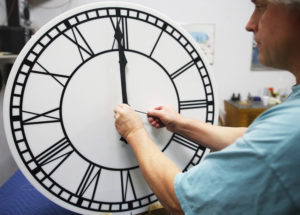
Peter Shugrue checks one of four custom, flush mounted clocks, destined for installation in Kansas City, Missouri, at the Electric Time Company factory in Medfield, Massachusetts March 8, 2013. Photo By Brian Snyder/Reuters
This wasn’t exactly ideal. A 35-mile bus trip from Steubenville, Ohio, to Moundsville, West Virginia, passed through seven distinct local time zones. The U.S. Naval Observatory dubbed the world’s greatest su perpower “the world’s worst timekeeper.â€
So, in 1966, Congress passed the Uniform Time Act, which mandated six months of standard time and six of daylight saving.
Great for golf â€" but what about everyone else?
Why do we still do it?
Today we know that changing the clocks does influence our behavior. For example, later sunset times have dramatically increased participation in afterschool sports programs and attendance at professional sports events. In 1920, The Washington Post reported that golf ball sales in 1918 â€" the first year of daylight saving â€" increased by 20 percent.
And when Congress extended daylight saving from six to seven months in 1986, the golf industry estimated that extra month was worth as much as US$400 million in additional equipment sales and green fees. To this day, the Nielsen ratings for even the most popular television shows decline precipitously when we spring forward, because we go outside to enjoy the sunlight.
But the promised energy savings â€" the presenting rationale for the policy â€" have never materialized.
In fact, the best studies we have prove that Americans use more domestic electricity when they practice daylight saving. Moreover, when we turn off the TV and go to the park or the mall in the evening sunlight, Americans don’t walk. We get in our cars and drive. Daylight saving actually increases gasoline consumption, and it’s a fallacious substitute for genuine energy conservation policy.
Lawmakers in Florida, of all places, ought to know that year-round daylight saving is not such a bright idea â€" especially in December and January, when most residents of the Sunshine State won’t see sunrise until about 8 a.m.
On Jan. 8, 1974, Richard Nixon forced Floridians and the entire nation into a year-round daylight saving â€" a vain attempt to stave off an energy crisis and lessen the impact of an OPEC oil embargo.
But before the end of the first month of daylight saving that January, eight children died in traffic accidents in Florida, and a spokesperson for Florida’s education department attributed six of those deaths directly to children going to school in darkness.
Lesson learned? Apparently not.
Michael Downing is a lecturer in creative writing for Tufts University. This article was originally published on The Conversation. Read the original story here.
Support Provided By: Learn more
Support PBS NewsHour:

Subscribe to Here’s the Deal, our politics newsletter for analysis you won’t find anywhere else.
Additional Support Provided By:


-
Watch Nov 02 Shields and Brooks on Trump’s focus on immigration, midterm closing arguments
-
Read Nov 03 Trump stumps in cities that don’t look that much like US
-
Read Nov 03 100 years later, the madness of daylight saving time endures
-
Read Nov 03 Police: 3 dead, including shooter, at Florida yoga studio
-
Read Nov 02 AP fact check: President Trump’s rhetoric and the truth about migrant caravans

Politics Nov 03
Parkland survivors vote for 1st time, months after massacre Politics Nov 03
Trump stumps in cities that don’t look that much like US Nation Nov 03
100 years later, the madness of daylight saving time endures World Nov 03
N. Korea threatens to resume nuke development over sanctions Nation Nov 03
Police: 3 dead, including shooter, at Florida yoga studio Poetry Nov 02
These wicked Day of the Dead poems don’t spare anyone Making Sen$e Nov 02
4 myths about how immigrants affect the U.S. economy Politics Nov 02
Supreme Court allows lawsuit over census citizenship question to move forward Nation Nov 02
For farmers, talking about mental health used to be taboo. Now there’s #AgTwitter Making Sen$e Nov 02
Maine might fund senior home care. How do most Americans pay? Politics Nov 02
Hospitals help patients get out the vote while stuck in bed Politics Nov 02
Georgia must ease rule for voters proving citizenship, judge says Education Nov 02
Opinion: The false narrative driving the Harvard affirmative action case World Nov 02
Christian pilgrims in Egypt ambushed; ISIS claims responsibility World Nov 02
Fiancée of journalist Jamal Khashoggi asks Trump to press Saudis for his body Making Sen$e Nov 02
Wages are finally ticking up. Here’s why Politics Nov 02
Trump administration reimposes all U.S. sanctions on Iran Nation Nov 02
Don’t forget to fall back one hour Sunday Nation Nov 02
Authorities to transfer pipe bomb suspect to New York and won’t seek bail Politics Nov 02
AP fact check: President Trump’s rhetoric and the truth about migrant caravansSource: Google News | Netizen 24 United States


ليست هناك تعليقات