China fossil tells new supercontinent story Science & Environment ...
Science & Environment Science & Environment China fossil tells new supercontinent story
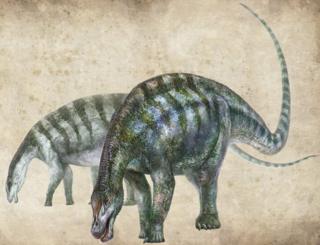 Image copyright Zhang Zongda
 A newly discovered dinosaur may be re-writing China's geological history, according to recent findings.
The latest addition to the family of giant, long-necked dinosaurs known as sauropods, Lingwulong shenqi lived in the north of the country about 174 million years ago.
At this time, East Asia was thought to have split from the supercontinent Pangaea.
But Lingwulong may be evidence that that was not the case.
- Fossil of 'first giant' discovered
- Does Jurassic Park make scientific sense?
- Ancient sea reptile one of the largest animals ever
Part of a subgroup called the neosauropods, which included brontosaurus, diplodocus and brachiosaurus, Lingwulong appeared exactly where it shouldn't - in northern China, 15 million years earlier than any other known dinosaurs from this group.
Dr Philip Mannion from Imperial College London, an author on the study, described the discovery as "doubly unexpected."
"Not only is it the oldest member [of this group], but it's the first ever from Asia. For a long time it was thought that neosauropods didn't get into Asia during the Jurassic," he told BBC News.
At the time, Pangaea was beginning to fragment. It has been proposed that a sea, much like the Red Sea but larger, separated what is now China from the rest of the supercontinent, preventing animals from crossing.
"This suggests that firstly [neosauropods] got in before any kind of barrier came up, but in creasingly the geological evidence suggests maybe this barrier was quite ephemeral," says Dr Mannion.
Despite neosauropods being plentiful throughout other areas of Pangaea - now North America, Europe and eastern Africa - none older than 160 million years old had previously been found.
Lingwulong now takes its place as the oldest known member of this family. But it may also show that these dinosaurs were at a much more advanced stage of evolution than previously thought - taking their diversification back from the middle to at least the early Jurassic.
Contrary to the idea that the dinosaurs "failed" because they died out in the wake of the Chicxulub impact, they were actually very successful at evolving and adapting, enduring for many millions of years. They survived several mass extinctions on Earth caused by extensive volcanic activity, and went on to thrive.
The discovery of Lingwulong is further evidence of this, says Dr Cecilia Apaldetti of CONICET-Universidad Nacional de San Juan in Argentina
"This new sauropod Lingwulong and the recent Ingentia - related to the origin of Sauropoda - reveal that dinosaurs had an unusual ability to i nnovate anatomically from the beginning of their evolution," the palaeontologist, who was not involved in the study, told BBC News.
"This allowed them to dominate and prevail in almost any terrestrial ecosystem for millions of years. This 'anatomical versatility' was probably one of the evolutionary keys that led them to be one of the most successful vertebrates in the history of life on earth," she added.
The study was published in Nature Communications.
Follow Mary on Twitter.
Top Stories
Wildfires kill dozens on Greek coastAt least 74 people are confirmed dead in the country's worst fire disaster in more than a decade.
24 July 2018 Greece fire survivors 'fled to the sea' 24 July 2018 Hundreds missing after Laos dam collapses 24 July 2018Features
VideoThis is the cost of getting shot in America
Fears of 'creeping coup' in Pakistan
Young people realising their full potential
The health scandal that killed both my husbands
The woman turning male judo upside down
The story behind Zimbabwe's scarf
VideoBBC Innovators: Africa's Invention School
BBC Capital: How a single comma can cost millions
Bannon plan for Europe populist 'supergroup' sparks alarm
Elsewhere on the BBC
Football phrases
15 sayings from around the world
Full article Football phrases Why you can trust BBC NewsBBC News Services
- On your mobile
- On your connected tv
- Get news alerts
- Contact BBC News


No comments